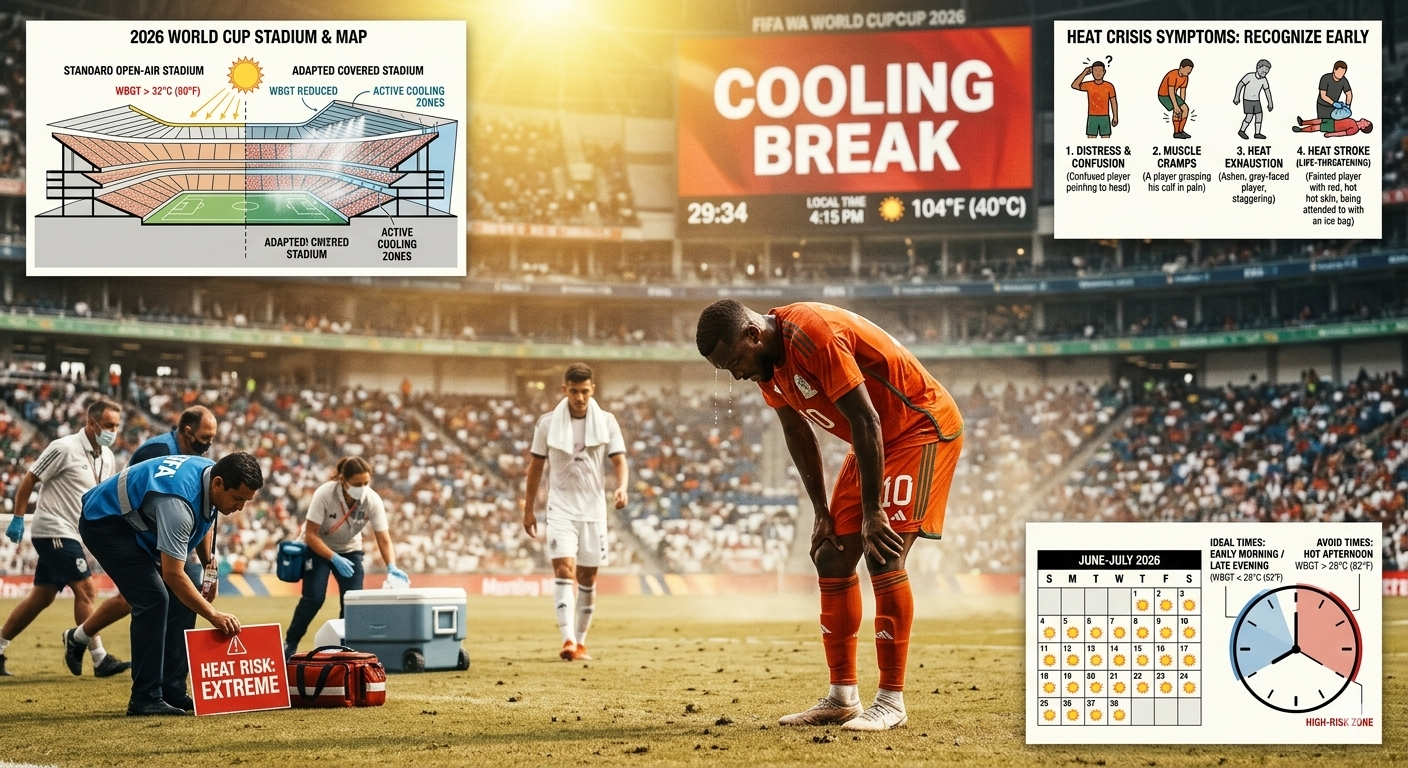
As anticipation builds for the 2026 FIFA World Cup across the United States, Canada, and Mexico, scientists and player unions are warning that extreme summer heat could become one of the tournament’s biggest challenges.
The expanded tournament — featuring 48 national teams and 104 matches — will take place during June and July, historically the hottest months across much of North America. Researchers say soaring temperatures, combined with rising humidity linked to climate change, could create dangerous conditions not only for players, but also for fans, stadium workers, and volunteers.
Heat index concerns are growing in multiple host cities
Recent climate studies suggest the risks are substantial. A review published in Sports Medicine found that 14 of the 16 host cities are likely to experience Wet Bulb Globe Temperatures (WBGT) above 28°C during the tournament — a threshold where heat stress can become dangerous for elite athletes. Six venues could even reach WBGT levels between 30°C and 35°C.
Medical experts warn that high WBGT conditions increase the risk of dehydration, exhaustion, and heatstroke. The concern is especially serious in cities such as Dallas, Houston, Miami, and Monterrey, where afternoon temperatures and humidity levels can become oppressive during the summer months.
A separate analysis released this week found that nearly one in four World Cup matches could be played in what researchers classify as “dangerous heat conditions.” Scientists involved in the study say climate change has significantly increased the likelihood of extreme heat compared to the 1994 World Cup, which was also hosted in North America.
Players and fans already experienced intense conditions at recent FIFA events
The issue already surfaced during recent FIFA tournaments in the United States. Players competing in the FIFA Club World Cup last summer described brutal playing conditions during daytime matches, while fans reported struggling with heat and humidity in open-air stadiums.
Online discussions among supporters have also highlighted concerns about long transit times, limited shade, and overcrowded public transportation systems in major host cities.
FIFA is considering mitigation measures ahead of the tournament
FIFA has announced several mitigation measures ahead of the tournament, including mandatory cooling breaks during matches, climate-controlled benches, and expanded medical planning. Organizers are also considering scheduling more matches later in the evening to avoid peak daytime temperatures.
Still, many experts believe stronger action may be needed.
Researchers from Brunel University London recently urged FIFA to rethink kickoff times entirely, arguing that some stadiums could exceed safe heat thresholds for much of the tournament.
“Almost 90 percent of stadiums hosting the 2026 FIFA World Cup could face dangerous heat levels,” the university warned in a recent report.
Player unions call for stricter safety protocols
Players’ union FIFPRO has also called for stricter heat safety protocols, including lower temperature thresholds for delaying or postponing matches. Current FIFA policies only mandate cooling breaks once WBGT levels hit 32°C.
Critics argue that waiting until conditions become that severe may put both athletes and spectators at unnecessary risk.
Climate change may reshape the future of major sporting events
The concerns come as climate scientists increasingly warn that major sporting events may need to adapt to a warming world. Some experts now believe the 2026 World Cup could become a turning point for how global tournaments are scheduled in the future.
For millions of fans expected to travel across North America next summer, the world’s biggest sporting event may also become one of its hottest.
Stay Updated With Breaking Point News
As climate concerns surrounding the 2026 FIFA World Cup continue to grow, organizers, athletes, and fans alike will be watching closely to see how FIFA responds in the months ahead.
For more breaking sports, climate, and global news coverage, visit Breaking Point News and follow the latest developments surrounding the 2026 FIFA World Cup.