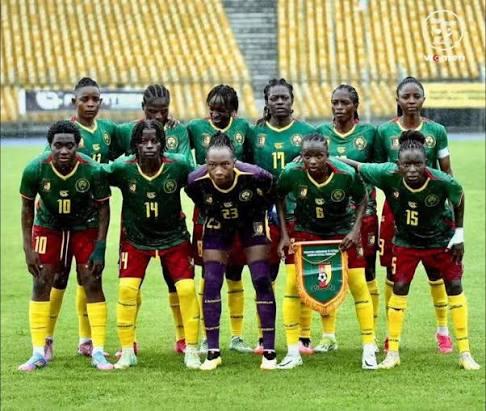
Twenty-two years after their first final, Cameroon are champions of Africa. The Indomitable Lionesses beat tournament debutants Malawi 3-0 in Rabat on Sunday to lift the Women's Africa Cup of Nations for the first time in their history — and they did it with a first-half performance that settled the match before Malawi could find their feet.
Two goals from Marie Ngah, either side of a Naomi Ndjoah Eto strike, ended the contest at the Prince Moulay El Hassan Stadium before the interval. Ngah struck twice, the second arriving in the 45th minute at the end of a blistering counter-attack, while Eto's composed finish past Mercy Sikelo made it two. Cameroon then managed the second half with discipline, frustrating a Malawi side pouring forward in search of a way back in.
A team that shouldn't have been there
Here's the detail that makes this title remarkable: Cameroon didn't originally qualify. They failed to make the 12-team competition and only got a lifeline when CAF expanded the tournament to 16 teams midway through the qualification process.
They then played like a side that knew it was on borrowed time. Cameroon managed just four goals across their first five matches of the tournament, with much of their progress driven by heroic goalkeeping from Benfica's Michaely Bihina—including four saves in a semi-final against hosts Morocco that finished goalless after 120 minutes before Cameroon won 3-1 on penalties. Marie Ngah, Rose Bella, and Myriam Nyadjou converted from the spot, while Kenza Chapelle, Meryem Atiq, and Sakina Ouzraoui all failed for Morocco. Morocco had their chance in the 118th minute, but Fatima Tagnaout missed the penalty that would have won it.
In the final, Bihina barely had to work. The attack that had been quiet all tournament finally arrived.
Ending three decades of near-misses
Cameroon had reached the WAFCON final three times before — in 2004, 2014, and 2016 — and lost every one. Sunday's win makes them only the fourth nation ever to lift the trophy, joining Nigeria, Equatorial Guinea, and South Africa in a genuinely exclusive club. For a country whose men's team has long been one of Africa's most decorated, the women finally have their own continental crown.
Malawi's fairytale ends one game short
Malawi has nothing to be ashamed of. Ranked 153rd in the world, the Scorchers reached the final on their tournament debut—a run built almost entirely around sisters Tabitha and Temwa Chawinga, who between them scored nine of Malawi's 13 goals. In the semi-final against Algeria, captain Tabitha opened the scoring with a bicycle kick from a corner in the 34th minute and sealed a 3-1 win in the 76th, while Temwa scored her fifth of the tournament in first-half stoppage time, drawing level with Zambia's Barbra Banda in the Golden Boot race.
In the final, though, Cameroon's midfield simply cut off the supply. The Chawinga sisters were starved of service, and by the time Malawi adjusted, they were three down.
What it means beyond the trophy
There's a World Cup dimension to all of this. All four semi-finalists — Cameroon, Malawi, Morocco, and Algeria — secured automatic qualification for the 2027 FIFA Women's World Cup in Brazil. That means Malawi, a debutant at this tournament ranked outside the world's top 150, is going to a World Cup. So is Cameroon, who nearly weren't here at all.
The four losing quarter-finalists — Côte d'Ivoire, Ghana, South Africa, and Nigeria — were left to fight for two places in FIFA's inter-confederation playoff. That's a striking sentence: Nigeria, holders of a record 11 continental titles and defending champions coming into this tournament, exited at the quarter-final stage. South Africa, the 2022 winners, went the same way.
The bigger picture
The expansion from 12 to 16 teams was contested at the time. It's hard to argue with the results. The expanded field produced a debutant finalist, a first-time champion that only qualified because of the expansion itself, and the elimination of two former champions before the semi-finals. Whatever else it did, it made the tournament less predictable—and it handed World Cup places to nations that would never have been in the room otherwise.
For Cameroon, after three finals and 22 years of waiting, the wait is over.

Leave a comment
Your email address will not be published. Required fields are marked *